Pattern repeats: how to keep track of "repeat rows 1–8"
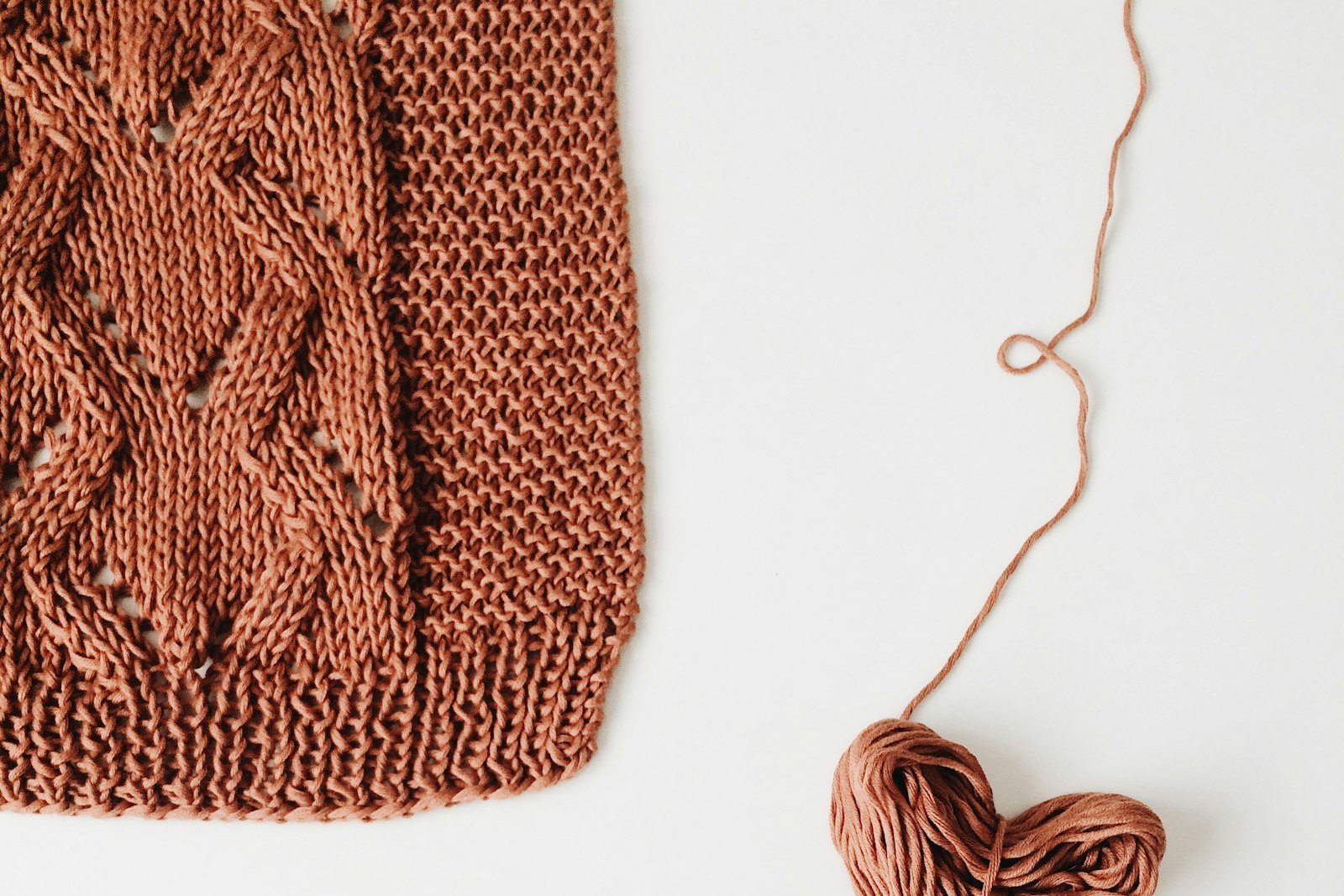
Photo: la crafter / Unsplash
When a pattern says "repeat rows 1–8", keep two numbers: the total row (how far you are into the piece) and the repeat row (where you are inside rows 1–8). Count the repeat with a counter that starts over after 8, and count how many times it has started over. That tells you which repeat you're on.
What "repeat rows 1–8" means
Patterns repeat at two levels, and it helps to keep them apart.
- Stitch repeats, inside one row. In the Craft Yarn Council's abbreviation list, a single asterisk means you repeat the instructions after it as directed, and brackets or parentheses mean you work what's inside as many times as the pattern says. *K2, p2; rep from * to end is a stitch repeat: it never changes your row count.
- Row repeats, across several rows. Repeat rows 1–8 six more times means you work the same eight rows again and again. Yarnspirations' guide to repeats shows the shortest version, "Repeat Rows 1 and 2", for a two-row stitch pattern.
Row repeats are where knitters and crocheters get lost, because the pattern stops telling you the row number. After the first eight rows, the text still says "row 5" but you might be on row 5 for the third time.
Total rows vs repeat rows
You need both numbers, for different reasons:
- The repeat row tells you which line of the stitch pattern to work next.
- The total row tells you how far you are in the piece: when to start shaping, when the sleeve is long enough, when the two fronts match.
- The repeat number (repeat 3 of 7) falls out of the two: it's how many times the repeat row has started over.
If the stitch pattern doesn't start on row 1 of the piece (a ribbed edge comes first, say), the repeat row and the total row are offset by the length of that edge. That offset is the whole trick of the example below.
A worked example
The pattern. Rows 1–3: rib. Then work lace rows 1–8 seven times. Then work 1 more row. Total: 3 + 7 × 8 + 1 = 60 rows.
The lace starts on total row 4, so:
Lace row = (total row − 3), counted 1 to 8 and starting over
Repeat = how many times it has started over, plus 1
| Total row | Lace row | Repeat | What happens |
|---|---|---|---|
| 1–3 | – | – | Rib |
| 4 | 1 | 1 of 7 | Lace starts |
| 11 | 8 | 1 of 7 | End of the first repeat |
| 12 | 1 | 2 of 7 | Counter starts over |
| 20 | 1 | 3 of 7 | Counter starts over |
| 24 | 5 | 3 of 7 | 24 − 3 = 21 = 2 × 8 + 5 |
| 52 | 1 | 7 of 7 | Last repeat |
| 59 | 8 | 7 of 7 | Lace done |
| 60 | – | – | Last row |
With two counters this is almost automatic: one counts the total row (1 to 60), the other counts lace rows and goes back to 1 after 8. Start the second one on total row 4. From then on, every time you add a row, both move together. If you lose your place, the table works backwards too: total row 24 can only be lace row 5 of repeat 3.
Shaping inside a repeat: notes every N rows
Garments often put shaping on top of a stitch pattern: "decrease 1 stitch at each end every 6th row, 5 times" while the lace keeps going. Now there are three rhythms: the lace (8 rows), the shaping (6 rows) and the total.
Example. Start decreasing on total row 10, then every 6 rows, 5 times: rows 10, 16, 22, 28 and 34. Those fall on lace rows 7, 5, 3, 1 and 7: a different lace row each time, which is why it's so easy to miss one.
Don't track this one in your head. Write the decrease rows down as total rows, before you start, and tick them off. Or let a note do it: a note that shows up "every 6 rows from row 10" catches every one of them. For fiddly shaping, the free Shaping tool helps you plan it, and Even spread handles increases or decreases spread evenly across one row.
Two repeats at once
Some designs run two panels side by side with different repeat lengths, like a 6-row cable next to a 4-row lace panel. Lion Brand's chart tips use exactly that pair: line the two up and they begin and end together every 12 rows, so you can combine them into a single 12-row chart.
You can work it two ways:
- One combined count. Write out (or tape together) a 12-row chart and count 1 to 12, starting over.
- One counter per panel. A cable counter that starts over after 6 and a lace counter that starts over after 4, both moving with every row. On row 9, the cable is on its row 3 and the lace on its row 1.
The first is better on paper. The second is easier with a counter app, and it doesn't care whether the numbers line up neatly (a 6-row and a 10-row panel only meet every 30 rows).
Paper, markers or an app
Any of these work if you use them every row:
- A sticky note under the current row, moved down after each row. Berroco's knit-along post recommends exactly this; its readers add highlighter tape, magnetic boards and a grid where each repeat gets its own column of ticks.
- Magnets on a chart, which Lion Brand suggests for larger charts, or one index card per row, flipped after each row.
- Tally marks for repeats, with a stitch marker clipped into the first row of each new repeat. Counting markers is quicker than counting lace holes.
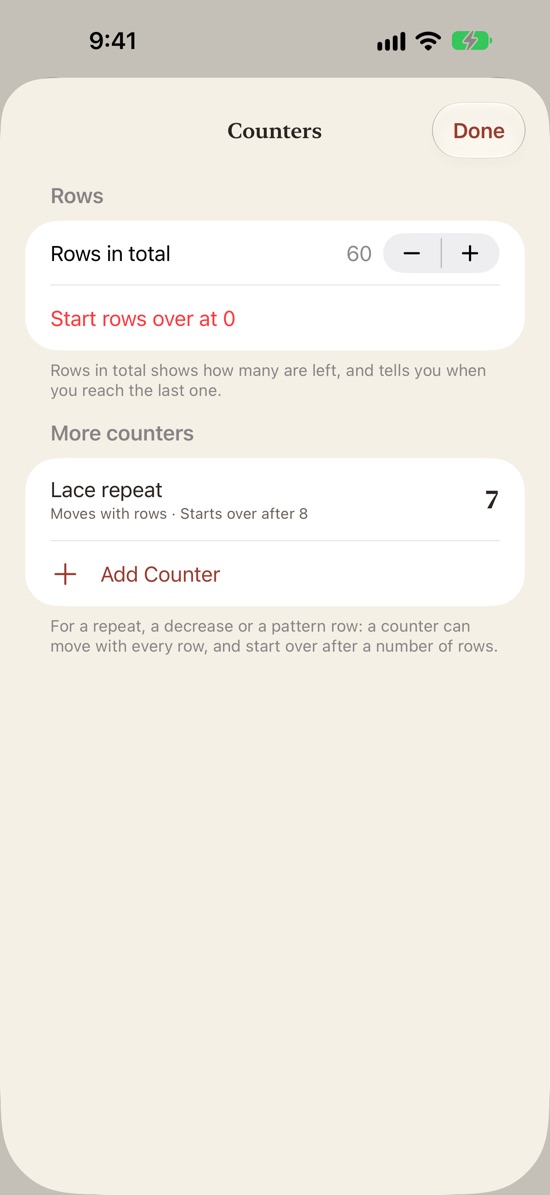
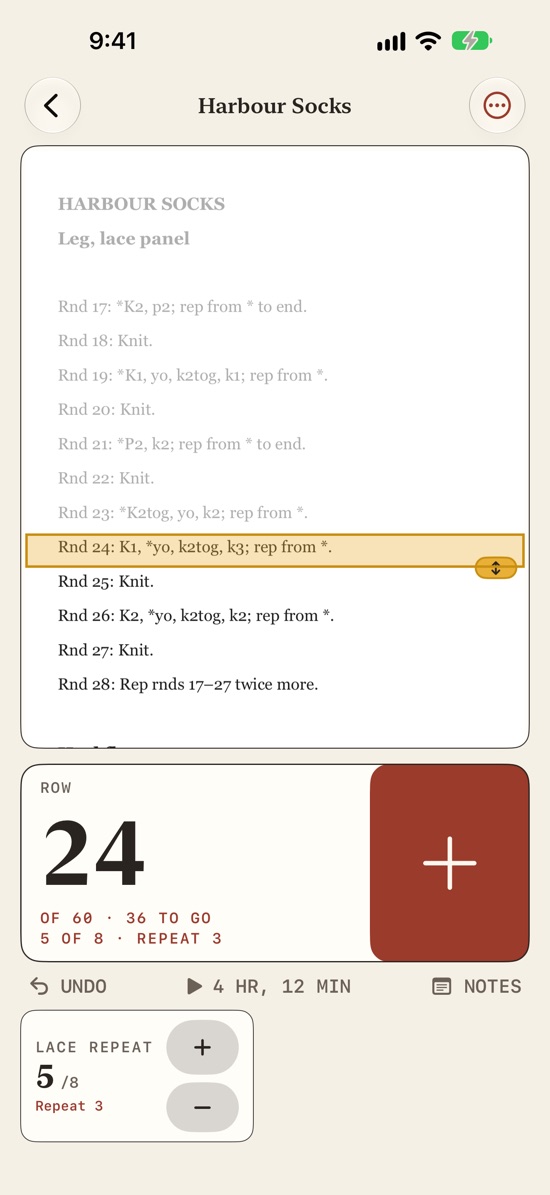
In Ballband, a project has its row counter with a total ("Rows in total: 60" shows how many are left) and extra counters alongside it. An extra counter can move with every row and start over after a number of rows, so the lace counter above is set to "starts over after 8" and the screen shows 5 of 8 · Repeat 3 under the row number. Row notes can show once or every N rows. The saffron line on your pattern follows the row counter; if you start a pattern part-way, drag the line (or touch and hold) onto the row you're on and it follows from there.
Quick answers
"Repeat rows 1–8 three more times": how many times is that in total?
Four. You've already worked rows 1–8 once; "three more times" adds three. "Work rows 1–8 three times" means three in total. Read it twice before you start.
What does "rep from *" mean?
Go back to the asterisk and work the instructions after it again, as many times as the pattern says, or to the end of the row. It's a stitch repeat inside one row and doesn't change the row count.
The pattern says "repeat until the piece measures 30 cm". Do I still need to count?
Yes. Note the total row and the repeat row where you stop, so the second sleeve or front can stop on the same row instead of the same measurement.
I lost my place in the repeat. How do I find it again?
Count the total rows from the fabric (or from your last marker), subtract the rows worked before the repeat started, and divide by the repeat length. What's left over is your repeat row.
- Craft Yarn Council: Knitting Abbreviations Master List (rep, *, [ ], ( )), checked 22 November 2026.
- Yarnspirations: How to Knit Repeats and Multiples, checked 22 November 2026.
- Lion Brand: More Tips for Working with Charts, checked 22 November 2026.
- Berroco: Happy Harvest Knit-along: Keeping Track of Your Rows, checked 22 November 2026.