How to read a crochet chart: symbols, rows and rounds
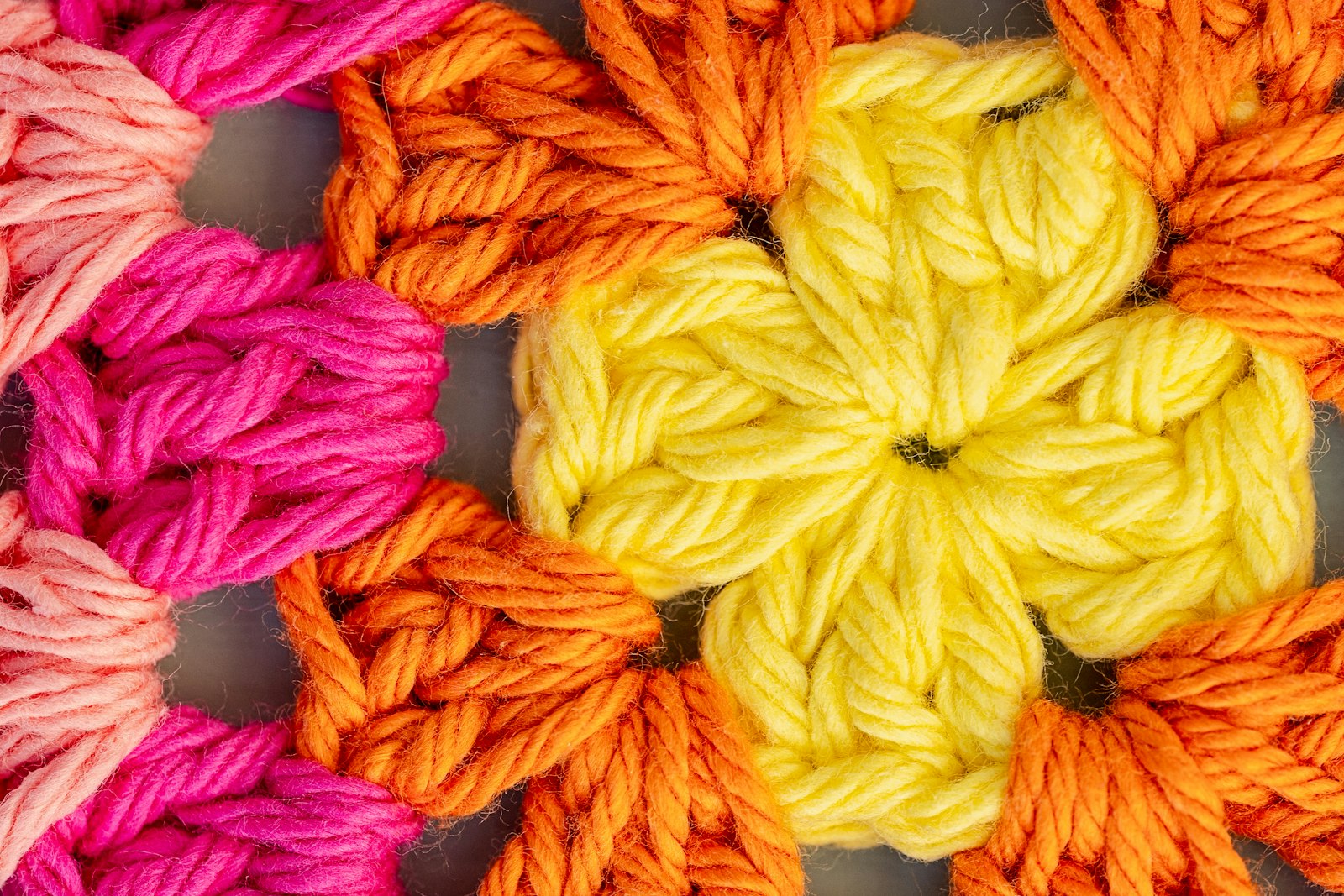
Photo: Cary Bates / Unsplash
A crochet chart draws every stitch as a symbol, placed where it sits in the fabric. Charts worked in rounds start in the center and go counterclockwise; charts worked in rows start at the bottom and go back and forth, right to left on one row and left to right on the next. The number beside each row or round shows where it begins.
What a crochet chart shows
Where a knitting chart is a grid of equal squares, a crochet chart is closer to a drawing of the finished piece. Each symbol is one stitch, drawn about as tall as the stitch is, and it sits on top of the stitch (or space) you work it into. A shell of five stitches fans out from one point because all five go into the same stitch below.
That makes crochet charts very readable once you know a handful of symbols, and it makes them useful even when you don't share a language with the designer. Most patterns that include a chart also include written instructions; use whichever you find easier and the other one to check.
The basic symbols
The Craft Yarn Council publishes a standard set of crochet chart symbols, and most publishers draw the basic stitches the same way. Taller stitches get taller symbols, and each slash across the stem stands for one yarn over before you insert the hook.
| Symbol | US name | UK name | Yarn overs before inserting the hook |
|---|---|---|---|
| Small oval | chain (ch) | chain (ch) | – |
| Filled dot or small filled oval | slip stitch (sl st) | slip stitch | 0 |
| X or + | single crochet (sc) | double crochet (dc) | 0 |
| T | half double crochet (hdc) | half treble (htr) | 1 |
| T with one slash | double crochet (dc) | treble (tr) | 1 |
| T with two slashes | treble crochet (tr) | double treble (dtr) | 2 |
The half double has a yarn over but no slash; what tells it apart from the double is its height and the missing slash. Every chart should come with a key, and the key wins: if your chart draws a stitch differently, follow the chart's own key.
Same symbol, US or UK name
US and UK crochet use the same names for different stitches. Only the chain and the slip stitch mean the same thing in both. The UK names are one step "taller": a US single crochet is a UK double crochet, a US double crochet is a UK treble. A chart sidesteps the confusion, because the symbol is the stitch. An X is the short stitch with no yarn over whatever you call it.
Where the confusion comes back is in the written instructions next to the chart. If a pattern says "dc" and the chart shows Xs, it's written in UK terms.
How to read a crochet chart in rounds
Granny squares, doilies, hats worked from the top and flat circles are charted in rounds.
- Start in the center. There's usually a ring of chains or a magic ring, drawn as a circle.
- Find the round's number. It sits beside the round's starting chain. Some charts add a small arrow at the start.
- Work counterclockwise (for right-handed crocheters), following the symbols around until you're back at the start.
- Close the round where the chart shows a slip stitch, then go out to the next round. Rounds often alternate colors on the chart so you can tell them apart.
Reading the chart above. Round 1: ch 1, then 6 Xs around the ring (6 sc), slip stitch into the first one. 6 stitches.
Round 2: a stack of 3 ovals (ch 3, which counts as the first double crochet), then double crochets in pairs: 2 on top of every stitch of Round 1. 6 stitches × 2 = 12 stitches, slip stitch to the top of the ch-3.
Notice how the chart shows the increase without saying "increase": two symbols grow out of one stitch below. That's the advantage of a chart. When your circle starts to ripple or cup, comparing your stitches with the chart shows where a pair went missing or doubled.
Not every round is joined. Amigurumi and many hats are worked in a continuous spiral, and the written pattern will say so; there's no slip stitch and no starting chain, so a stitch marker in the first stitch of each round does the job the round number would.
How to read a crochet chart in rows
Flat pieces worked back and forth are charted in rows, from the bottom up.
- The foundation chain is at the bottom, drawn as a line of ovals.
- A row numbered on the right is worked from right to left. That's normally a right-side row.
- A row numbered on the left is worked from left to right. That's the next row after you turn, normally a wrong-side row.
- The turning chain is drawn at the start of each row, on the same side as its number.
Some charts number only the right-side rows, or draw right-side rows in one color and wrong-side rows in another. Either way the rule holds: start each row on the side where its number or turning chain is.
Reading the chart above. Ch 8. Row 1 starts at the right: skip the first chain from the hook and work a single crochet into each of the other 7 chains. 7 stitches.
Turn. Row 2 starts at the left with its ch 3, which counts as the first double crochet, then 6 more double crochets. 1 + 6 = 7 stitches.
Turn. Row 3 starts at the right with ch 1, then a single crochet in each of the 7 stitches.
Starting and turning chains
Every row and round begins with a few chains that lift the hook to the height of the stitches in that row. The chart draws them as a short stack of ovals. Short stitches get short stacks: commonly ch 1 for single crochet, ch 2 for half double and ch 3 for double crochet.
The one thing a chart can't always show is whether those chains count as a stitch. In the examples above, the ch 3 does count (it stands in for the first double crochet), while the ch 1 before a row of single crochet doesn't. Patterns usually say "counts as dc" or "does not count as a stitch" in the written instructions. If your stitch count keeps coming out one too many or one too few, this is the first place to look.
Shells, colors, and left-handed crochet
- Shells and fans: several symbols spreading from one point are all worked into the same stitch or space.
- Clusters and bobbles: several symbols joined at the top are partial stitches finished together. Puffs are drawn without slashes; bobbles keep them, because each part is a partial double or treble.
- Colors on the chart: charts often alternate black with red or blue between rows or rounds. That's only to tell the rows apart. A separate color key, usually lettered, tells you when to change yarn.
- Left-handed: you work in mirror image. Rows that the chart reads from right to left go from left to right for you, and rounds travel clockwise in your hands even though the chart is drawn counterclockwise.
Corner-to-corner graphs are different
Corner-to-corner (C2C) blankets come with a different kind of chart: a pixel grid, where each square is a small block of stitches, not a single stitch. You work it in diagonal rows from one corner, adding a block on each diagonal until you reach the widest point, then removing one. Reading it is mostly a matter of knowing how many blocks each diagonal has and where the colors change along it.
Keeping your place
A round chart doesn't suit a sticky note, so mark it in pencil instead: tick each round as you close it, and write the stitch count you should have beside the round number. On a row chart, cover the rows above the one you're working. Keep a running count of rows or rounds, separate from the chart, so that a put-down project starts again on the right line.
Questions
Which way do you read a crochet chart?
Rounds go counterclockwise from the center. Rows go from the bottom up: a row numbered on the right is read right to left, a row numbered on the left is read left to right.
What does the T with a line through it mean in crochet?
A double crochet in US terms (a treble in UK terms). The slash stands for the one yarn over you make before inserting the hook. Two slashes is a US treble.
What does the dot mean on a crochet chart?
A filled dot or small filled oval is a slip stitch, often the one that joins the end of a round to its start.
Are crochet chart symbols US or UK?
Neither: the symbols are the same in both. Only the names differ, so check which terms the written part of the pattern uses.
How do left-handed crocheters read a chart?
Read it as printed, but work in mirror image: rows go the opposite way and rounds travel clockwise.
- Craft Yarn Council: Crochet Chart Symbols (standard symbols; most show the stitch from the right side; check the pattern key), checked 22 Nov 2026.
- Craft Yarn Council: Crochet Abbreviations Master List (ch, sl st, sc, hdc, dc, tr, t-ch), checked 22 Nov 2026.
- Yarnspirations: How to Read Crochet Symbol Charts (rounds from the center, counterclockwise for right-handers; row numbers; hdc, dc and tr symbols; row colors), checked 22 Nov 2026.
- LoveCrafts: How to read crochet charts (US and UK names; crossbars are yarn overs; shells, puffs and bobbles), checked 22 Nov 2026.
- DMC: Understanding UK Crochet Charts and Symbols (rows from the bottom right; rounds from the center, anticlockwise), checked 22 Nov 2026.
- Dummies: How to Follow a Stitch Diagram in Crochet (row number on the right means right to left; left-handed crocheters work in reverse), checked 22 Nov 2026.