How to count rows in knitting (stockinette, garter, rib)
Photo: Yuliia Pakhomova / Unsplash
To count rows in knitting, start just above the cast-on edge and count upward. In stockinette, count the Vs in one column on the right side. In garter stitch, count the ridges: each ridge is two rows. The loops on your needle are the row you just finished.
What counts as a row?
Two edges cause most miscounts: the bottom and the top.
- The cast-on is not a row. It forms the edge the first row hangs from, and it often looks a little different from the rows above it. Lion Brand's guide leaves it out of the count. In garter stitch it can look exactly like a ridge, which is why it trips people up.
- The loops on your needle are the row you just worked. They haven't become Vs in the fabric yet, but they are a finished row. If you can see 6 rows of Vs below the needle, you have worked 7 rows and the next one is row 8.
Check how your pattern numbers its rows. Many call the first row after the cast-on "Row 1", and many add "(RS)" or "(WS)" to tell you which side is facing. If the count you read off the fabric and the row your pattern says you're on disagree, settle it now, before the next shaping row.
How to count rows in stockinette
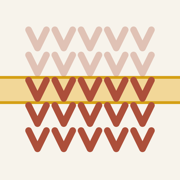
On the right side (the smooth, knit side), every stitch looks like a small V. Each horizontal line of Vs is one row.
- Lay the piece flat with the right side facing you and the needle at the top.
- Pick one column of Vs near the middle, away from the edge stitches, which are often loose or twisted.
- Start with the first full V above the cast-on edge and count upward, one V per row.
- Stop at the needle and add one for the row on the needle.
Example. One column shows 6 Vs between the cast-on edge and the needle.
6 rows in the fabric + 1 row on the needle = 7 rows worked. Your next row is row 8.
A few things make it easier. A ruler or the edge of a card held along the column keeps your eye from drifting sideways. With fuzzy or very dark yarn, Berroco suggests gently stretching the fabric so the rows separate, but not while you're measuring row gauge, because stretching changes the measurement. If the right side is hard to read, turn the piece over: on the purl side each row is a line of small curved bumps, which can be easier to see in mohair or variegated yarn.
Reverse stockinette (purl side as the right side) is harder to read from the front. Count from the back, where the fabric looks like ordinary stockinette.
How to count rows in garter stitch
In garter stitch you knit every row, and the fabric turns into horizontal ridges with valleys between them. Knit Picks puts it simply: each ridge on the right side stands for two rows of knitting.
- Count the ridges on one side, starting above the cast-on edge.
- Multiply by two.
- If you've worked an odd number of rows, the last row only shows as half a ridge. To check, count the ridges on the other side too and add the two counts together.
Example. 4 ridges on the front × 2 = 8 rows.
Counting both sides: 4 ridges on the front + 5 on the back = 9 rows, so you've just finished an odd row.
Garter is the easiest fabric to count by eye. It is also the easiest to miscount at the bottom, because the cast-on edge looks like one more ridge. Lion Brand's example counts four ridges on one side and five on the other for nine rows, with the cast-on left out.
How to count rows in ribbing
Ribbing (k1, p1 or k2, p2) is columns of knit stitches next to columns of purl stitches. On the right side, each knit column is a little strip of stockinette, so the stockinette method works: pick one knit column and count its Vs from the cast-on up, then add the row on the needle.
Ribbing pulls in, so the purl columns hide behind the knit ones. Spread the fabric a little sideways (not up and down) to open the columns. Don't count purl bumps in ribbing; they sit in recessed columns and are easy to skip or double-count.
Lace, cables and fuzzy yarn
Some fabrics are hard to read: lace with lots of holes, textured stitch patterns, bouclé, mohair, very dark yarn. Two habits help.
- Count from a landmark, not from the bottom. A cable crossing is easy to spot. Lion Brand suggests putting a removable marker or a safety pin into a stitch on a row you've just completed, like a cable crossing row, and counting up from there.
- Mark every tenth row. Clip a removable marker into an edge stitch on rows 10, 20, 30 and so on. When you need a count, multiply the markers by 10 and count only the few rows above the last one.
This is also how you recover when you've lost your place. If your counter says 30 but the fabric shows 4 rows above the third marker, trust the fabric: you're on row 34, and the next row is 35.
Row counter, markers or both?
A counter tells you which row you're on while you knit. Reading the fabric tells you which row you're on after something went wrong: you put the work down mid-row, forgot to click, or clicked twice. Lion Brand's article makes the same point about counters of every kind: they only work if you remember to update them, so learning to read your stitches is the backup.
What works for most people:
- Count every row with a counter, at the same moment every time: right after you turn the work.
- Mark every tenth row with a removable marker.
- Check the fabric before every shaping row (increases, decreases, a buttonhole) and before you put the work away.
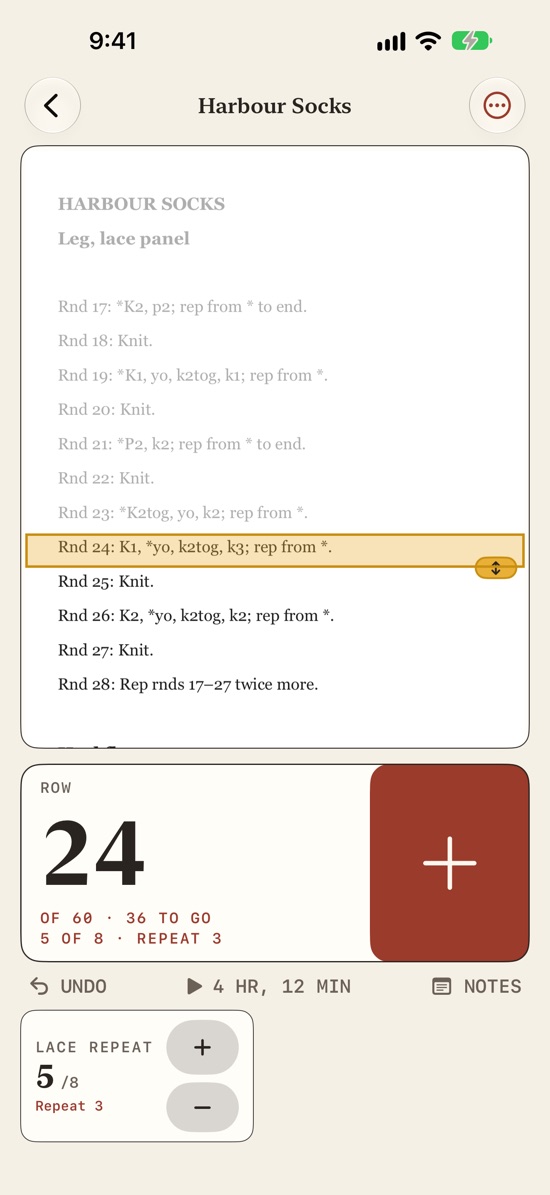
If you count on your phone, the counter can also keep your place on the pattern. In Ballband, the + adds a row and a saffron line on your PDF moves to that row: it reads the pattern's own "Row 12" or "Rnd 12" labels, so the line sits on the row the counter shows. Undo takes the last row back. You can attach a note to a row ("Row 30: start the heel") or to every few rows ("every 6 rows: decrease"), and it shows up when you get there.
Want to try following a pattern before installing anything? The free Pattern follower runs in your browser.
Quick answers
Does the cast-on row count as a row?
Usually not. Start counting with the first row of stitches above the cast-on edge. A few patterns do count it; if yours does, it will say so near the start.
Do the stitches on the needle count as a row?
Yes, they are the row you just finished. Count the Vs in the fabric and add one for the needle. 6 Vs plus the needle row means 7 rows worked.
How many rows is one garter ridge?
Two. Count the ridges on one side and multiply by two, or count the ridges on both sides and add them up, which also catches an odd last row.
How do I count rounds when knitting in the round?
The same way as stockinette: on the outside, count the Vs in one column from the cast-on up. Use a different-coloured marker for the beginning of the round so you know where each round starts.
My counter and my knitting disagree. Which is right?
The knitting. Count the fabric from your last marker, set the counter to that number, and carry on.
- Lion Brand: The Ups and Downs of Knitting: Counting Your Rows, checked 22 November 2026.
- Berroco Design Team Blog: Ask Amanda: How do I count my rows?, checked 22 November 2026.
- Knit Picks Tutorials: Garter Stitch, checked 22 November 2026.
- Craft Yarn Council: Knitting Abbreviations Master List (RS, WS, rnd), checked 22 November 2026.