How to count rows and rounds in crochet
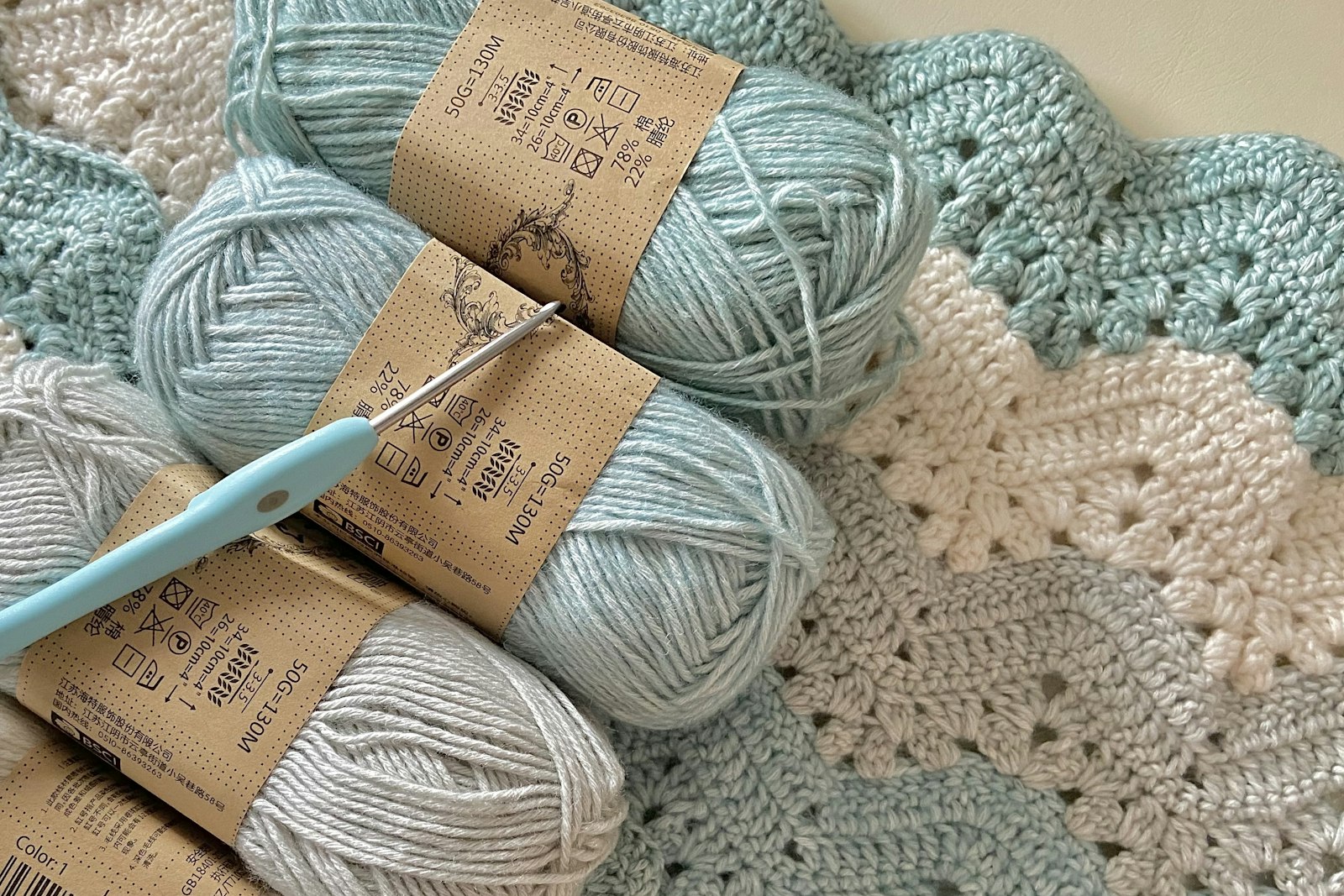
Photo: Joy Ru / Unsplash
Count crochet rows from the bottom up, starting with the first row of stitches above the foundation chain; the chain itself is not a row. Count rounds from the centre out, one ring per round. The turning chain matters too: in double crochet it usually counts as the first stitch, in single crochet it doesn't.
First: US or UK terms?
The same stitch has different names in US and UK patterns, and it changes how you read the fabric. A US single crochet is a UK double crochet; a US double crochet is a UK treble. Most patterns say which terms they use near the top. LoveCrafts adds a few clues if yours doesn't: "gauge" and yards point to US terms, "tension" and metres to UK terms.
This guide uses US terms throughout: sc (single crochet), hdc (half double), dc (double), tr (treble).
Turning chains: which ones count
At the start of each row you chain a few stitches to bring the hook up to the height of the next row. Whether that chain counts as a stitch depends on how tall the stitches are. Yarnspirations gives the usual numbers:
| Stitch (US) | Turning chain | Counts as a stitch? |
|---|---|---|
| Single crochet (sc) | ch 1 | No, it's for height only |
| Half double crochet (hdc) | ch 2 | Usually yes |
| Double crochet (dc) | ch 3 | Usually yes |
| Treble crochet (tr) | ch 4 | Usually yes |
"Usually" is doing real work there: some patterns tell you the chain does not count, and then you work a stitch into the first stitch as well. When a pattern says "ch 3 (counts as dc)", it does count. Getting this wrong doesn't change your row count, but it adds or loses a stitch at the edge every row, which is how a straight piece turns into a trapezoid.
How to count rows of double crochet
Tall stitches are the easy ones. Each double crochet has a long post, and each row is one layer of posts.
- Lay the work flat. Find the foundation chain at the bottom; it isn't a row.
- Pick one column of stitches away from the edges and count the posts upward, one post per row.
- Check at an edge: because you turn at the end of every row, the ch-3 that starts each row appears on alternate sides. One edge shows a turning chain on rows 1, 3, 5…, the other on rows 2, 4, 6….
Example. Above the foundation chain you can see 4 layers of posts, with turning chains on the left at rows 1 and 3 and on the right at rows 2 and 4.
That's 4 rows. Each row has 9 stitches: the ch-3 plus 8 dc.
Half double crochet is in between: Stitch & Story notes that hdc fabric shows a ridge after every second row, with bumps between the ridges, so count those carefully or count posts at the edge instead.
How to count rows of single crochet
Single crochet is short and dense, so the rows run together. Three ways to read it:
- Count the ridges and double them. Worked back and forth, single crochet forms a ridge that is really two rows worked in opposite directions (Stitch & Story describes it this way). Count ridges on one side, multiply by two, and check the last row on the other side, just like garter stitch in knitting.
- Count at the edge. Each row leaves one small bump or turning chain at the side. These are often easier to see than the stitches in the middle.
- Stretch it gently. Pulling the fabric a little opens the gaps between rows.
The Crochet Guild of America's single crochet lesson adds the habit that saves most projects: count your stitches after every row. Its practice swatch starts with 13 chains and gives 12 single crochet in every row, because the ch-1 turning chain is not a stitch. If row 7 has 11, you've lost a stitch at the edge, and you'll find it faster now than at row 30.
How to count rounds
Rounds (abbreviated "rnd" in patterns) are worked in a circle without turning, so you count from the centre outward. There are two ways of working them, and they look different.
Joined rounds
You finish each round with a slip stitch into the top of the first stitch, then chain up and start the next round. Simply Crochet's guide to working in the round walks through it. Every join leaves a small mark, and the marks line up into a seam that runs from the centre to the edge. That seam is the easiest place to count: one join, one round. The seam may lean a little rather than run straight, so follow it stitch by stitch.
Spiral rounds
Spiral rounds aren't joined: you crochet straight into the first stitch of the previous round, which is how most amigurumi is made. There's no seam to count, and that's exactly why you need a stitch marker. Put it in the first stitch of each round and move it up when you get back to it. Counting rounds afterwards means counting rings out from the centre along a line, which is easier if you've also clipped a second marker in every fifth or tenth round.
Use the stitch count as a check
Flat circles grow by the same number of stitches every round, so the stitch count tells you which round you're on. A common start is 6 stitches in round 1, then 12, 18, 24 and 30 (the Simply Crochet example uses this sequence).
Example. Your circle has 24 stitches in its outer round and grows by 6 a round: 24 ÷ 6 = round 4. If you count 23 or 25, the round count may be right but an increase was missed or doubled.
Keep the count while you work
Reading the fabric is the backup. Day to day, it's easier not to lose count in the first place:
- Count every row at the same moment, right after you turn (or right after the join in rounds).
- Mark every tenth row with a removable marker in an edge stitch. Markers × 10, plus the rows above the last one, is your count.
- Write the stitch count down next to the row number when it changes.
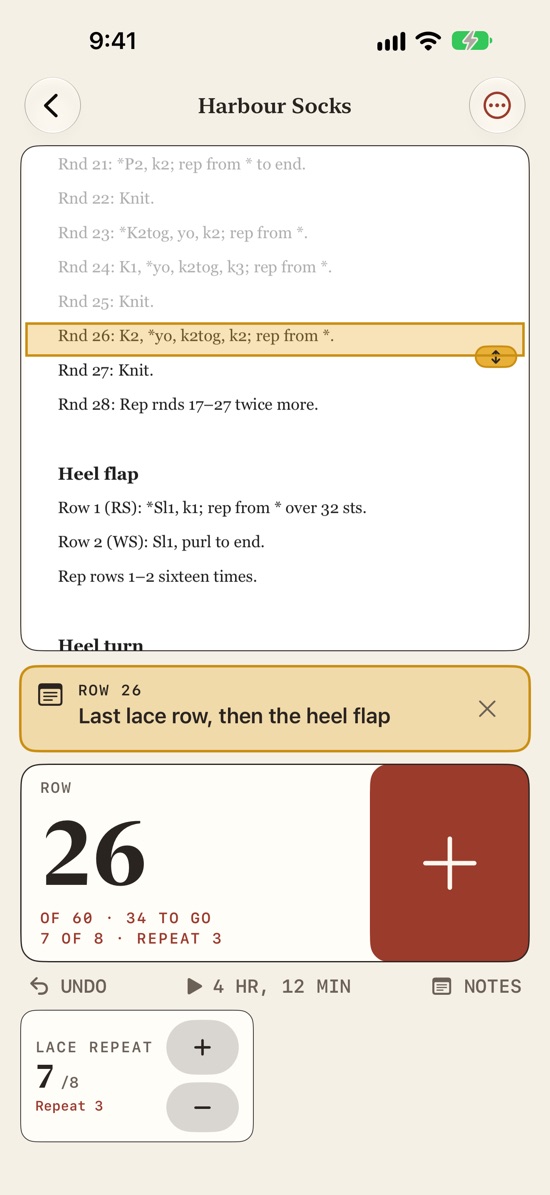
Ballband does the counting on your phone and keeps your place in the pattern at the same time. Add a row and the saffron line on your PDF moves to it; it reads the pattern's own row labels, including "Row 5" and "Rnd 5", so it lands on the right line even when an instruction wraps over two lines. A note can pop up on a given row, or every few rows, and for corner-to-corner blankets there's a counter that knows whether you're increasing or decreasing and how many blocks the next diagonal row needs.
Planning a corner-to-corner piece? Try the free C2C tool in your browser first.
Quick answers
Does the foundation chain count as a row?
No. Start counting with the first row of stitches worked into the chain.
Does the turning chain count as a stitch?
For single crochet, no: the ch 1 is only for height. For half double, double and treble crochet it usually counts as the first stitch. Your pattern will say if it's different.
How do I count rounds in amigurumi?
Amigurumi is usually worked in spiral rounds, so keep a marker in the first stitch of every round and move it up as you go. To count afterwards, follow a line of stitches from the centre out, one ring per round, and check against the stitch count.
Why do my edges grow or shrink?
Most often the turning chain: counting a ch 1 as a stitch in single crochet, or working into the ch 3 when it already counts as a stitch (or skipping it when it should). Count your stitches at the end of every row.
- Yarnspirations: How to Make Crochet Fabric (turning chain heights), checked 22 November 2026.
- Crochet Guild of America: Single Crochet, checked 22 November 2026.
- Stitch & Story: How to Count Crochet Rounds and Rows, checked 22 November 2026.
- Simply Crochet (Simply Yarn): How to crochet in the round, checked 22 November 2026.
- LoveCrafts: Crochet terms, UK vs US, checked 22 November 2026.
- Craft Yarn Council: Crochet Abbreviations Master List (rnd, t-ch, sl st), checked 22 November 2026.