How to decrease evenly across a row (with examples)
Photo: Yuliia Pakhomova / Unsplash
To decrease evenly, remember that every decrease uses two stitches. Take those out first, then divide what's left by the number of decreases. 60 stitches with 6 decreases leaves 60 − 12 = 48 plain stitches, and 48 ÷ 6 = 8. In the round that's [work 8, dec] × 6, which leaves you with 54.
The method
A pattern line like "decrease 6 sts evenly around" or "dec 7 sts evenly across" gives you the number and leaves the spacing to you. Here's how to work it out:
- Take the decrease stitches out. A k2tog (or any single decrease) turns 2 stitches into 1. So 6 decreases use 12 stitches. 60 − 12 = 48 stitches are worked plain.
- Divide the plain stitches by the number of decreases. 48 ÷ 6 = 8. Each group is 8 plain stitches, then a decrease.
- Spread any remainder through the row, one extra stitch in some of the groups.
- If you're working flat, halve one group and put the halves at both ends, so no decrease sits on an edge stitch.
- Add the line up. Plain stitches plus 2 for every decrease must equal what's on your needle now; the new count is the old one minus the number of decreases.
Kate Atherley's Modern Daily Knitting article on spacing makes the key point for decreases: the spacing methods are the same as for increases, except that each decrease takes two stitches out of its group. Lion Brand's guide to evenly spaced shaping uses 80 stitches decreased by 10 as its example: the decrease is worked on the 7th and 8th stitches of each group of 8. That's exactly [work 6, dec] × 10, which is what our free even spread calculator gives for 80 → 70 in the round.
Worked example in the round: 60 to 54
The pattern says: decrease 6 stitches evenly around. You have 60.
Take the decreases out: 6 decreases × 2 stitches = 12. 60 − 12 = 48 plain stitches.
Divide: 48 ÷ 6 = 8.
Instruction: [work 8, dec] × 6. For stockinette: [k8, k2tog] × 6.
Check: each repeat uses 10 stitches (8 + 2) and leaves 9. 6 × 10 = 60 in, 6 × 9 = 54 out.
There's a shortcut hidden in that check: 60 ÷ 6 = 10 is the size of each whole repeat, decrease included. If the stitch count divides by the number of decreases, the repeat is that size and the plain part is two less. The longer method above still matters, because it is the one that works when the numbers don't divide.
Worked example flat: 60 to 54
The same numbers worked back and forth need two half groups at the edges.
Plain stitches: 48, in 6 groups of 8. One group is split into 4 + 4 for the two ends.
Instruction: work 4, dec, [work 8, dec] × 5, work 4.
Check: 4 + 2 + (5 × 10) + 4 = 60 stitches in. Six decreases, so 54 stitches out.
Count the decreases: one after the first 4 stitches and five inside the bracket. Six. The row starts and ends with 4 plain stitches, which keeps the edges clean for seaming or picking up.
When it doesn't divide: 75 to 68 flat
Here's a less tidy one: 75 stitches, decrease 7 evenly, worked flat.
Take the decreases out: 7 × 2 = 14. 75 − 14 = 61 plain stitches.
Divide: 61 ÷ 7 = 8.71. The groups will be a mix of 8s and 9s, with half groups at the edges.
Instruction: work 4, dec, [work 9, dec] × 3, work 8, dec, [work 9, dec] × 2, work 4.
Check: 4 + 2 + (3 × 11) + (8 + 2) + (2 × 11) + 4 = 75 stitches in. Seven decreases, so 68 out.
Worked in the round, the same 75 → 68 becomes work 9, dec, work 8, dec, [work 9, dec] × 3, work 8, dec, work 9, dec. The two 8-stitch groups sit apart rather than next to each other. Lines like these are tedious to work out by hand and easy to get one stitch wrong; the even spread calculator writes them for you, flat or in the round.
The mistake that makes you run out of stitches
The most common slip is dividing the whole count by the number of decreases and then working that many plain stitches before each decrease. With 60 stitches and 6 decreases, 60 ÷ 6 = 10, so you work "k10, k2tog". But that repeat uses 12 stitches, not 10. Six of them would need 72 stitches: the fifth repeat uses up your last stitch and the sixth decrease never happens.
Either divide the plain stitches (48 ÷ 6 = 8, then k8, k2tog), or divide the whole count and remember the decrease is part of the group (10 stitches = k8, k2tog). Both give the same answer. The first way also handles remainders.
Quick test before you start: multiply one repeat (plain + 2) by the number of repeats and add the edge stitches. If that isn't your current stitch count, the line is wrong.
Which decrease to use
- k2tog (knit 2 together) is the usual choice for an evenly spaced decrease row. The Craft Yarn Council lists it as a single right-leaning decrease.
- ssk leans the other way. Spread across a row with plain stitches between, the lean hardly shows, so most patterns don't mind which you use. Where the lean does matter is at the edges of shaped pieces; Knitty's Wiseknit column on fully fashioned decreases shows how left- and right-leaning decreases are paired there.
- p2tog on a wrong-side row, so the decrease looks like a k2tog from the right side.
- Crochet: a decrease such as sc2tog (single crochet two together) also turns two stitches into one, so the arithmetic is identical.
If the decrease row is also where the stitch pattern changes, for example from stockinette into ribbing, work the decreases in the old pattern and start the new one on the next row unless the pattern says otherwise.
Quick table of common counts
All lines were produced by the same rule as the calculator: decreases use two stitches each, the remaining stitches are shared out, and flat rows get half groups at both ends.
| Stitches | Flat | In the round |
|---|---|---|
| 60 → 54 | work 4, dec, [work 8, dec] × 5, work 4 | [work 8, dec] × 6 |
| 64 → 56 | work 3, dec, [work 6, dec] × 7, work 3 | [work 6, dec] × 8 |
| 72 → 64 | work 4, dec, [work 7, dec] × 7, work 3 | [work 7, dec] × 8 |
| 80 → 70 | work 3, dec, [work 6, dec] × 9, work 3 | [work 6, dec] × 10 |
| 96 → 88 | work 5, dec, [work 10, dec] × 7, work 5 | [work 10, dec] × 8 |
| 100 → 90 | work 4, dec, [work 8, dec] × 9, work 4 | [work 8, dec] × 10 |
| 120 → 108 | work 4, dec, [work 8, dec] × 11, work 4 | [work 8, dec] × 12 |
Mark the row so it doesn't slip past
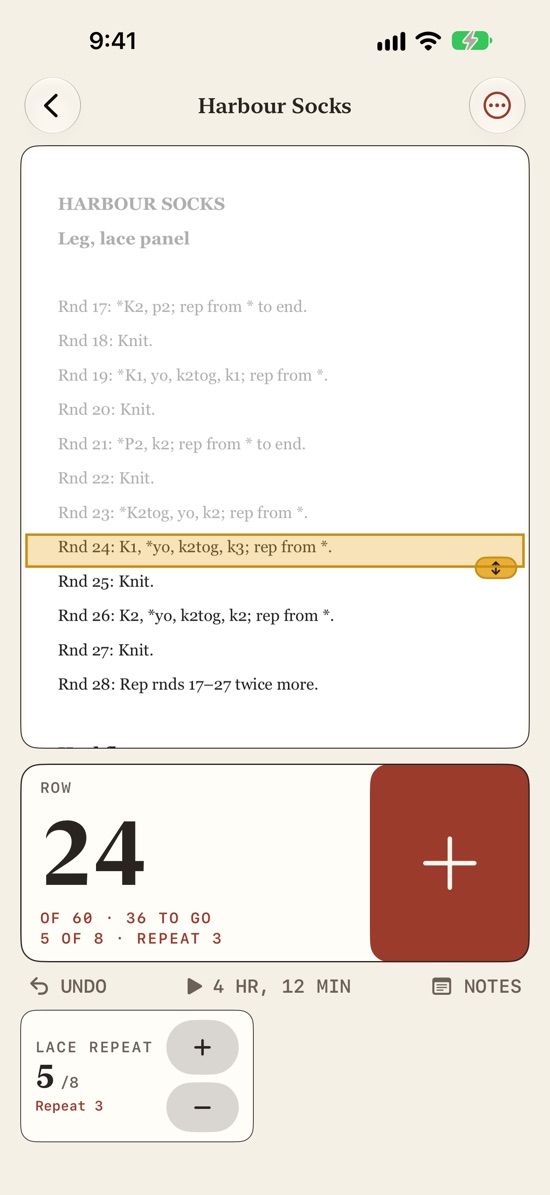
An evenly spaced decrease row usually comes at a turning point: the top of a hat brim, the waist of a sweater, the start of a yoke. It's the row you most need to notice, and the easiest to miss when you're counting the plain rows around it. Mark it on your printed pattern, or let the pattern do the marking for you.
Ballband puts a line on your PDF or photographed pattern that moves down a row each time you count, so you can see the decrease row coming. You can also add a row note with the full line ("[k8, k2tog] × 6") and it appears when the counter reaches that row.
Questions
What does "decrease evenly around" mean?
It means work the given number of decreases spread as evenly as possible over the whole round instead of in one spot. Subtract two stitches per decrease, divide what's left by the number of decreases, and work that many stitches before each decrease.
Why do I need to subtract the decrease stitches first?
Because each decrease uses two stitches from the needle. If you divide the full count and work that many plain stitches before each decrease, every repeat is two stitches too long and you run out before the end of the row.
What if my numbers don't divide evenly?
Make some groups one stitch longer and spread them through the row. The exact place of a single extra stitch won't show; the final stitch count is what matters.
Does this work for crochet?
Yes. A crochet decrease such as sc2tog also works two stitches into one, so the same lines apply: "work 8, dec" is 8 single crochet, then sc2tog.
Going the other way? See how to increase evenly across a row. For decreases spread over many rows instead of one, like a tapering sleeve, see how to read "decrease every 6th row 8 times".
- Modern Daily Knitting: Techniques in Depth: Less Evenly Across? (Kate Atherley), checked 22 Nov 2026.
- Lion Brand Notebook: How to Evenly Space Your Increases/Decreases (Laura Yona), checked 22 Nov 2026.
- Craft Yarn Council: Knitting Abbreviations Master List (k2tog, dec), checked 22 Nov 2026.
- Knitty, Wiseknit: Fully Fashioned Shaping: Decreases (Kate Atherley, Spring + Summer 2025), checked 22 Nov 2026.