Corner to corner crochet: how to count rows and blocks
Photo: Joy Ru / Unsplash
A corner to corner (C2C) piece that is W blocks wide and H blocks high has W + H − 1 diagonal rows. Each row adds one block until the diagonal reaches the short side. On a rectangle it then holds that many blocks along the long side, and finally loses one block a row down to the last corner. A 30 × 40 graph is 69 rows: rows 1–30 increase, 31–40 stay at 30 blocks, 41–69 decrease.
Rows and blocks in C2C
C2C is worked in small square units, usually called blocks or tiles, set on the diagonal. In the most common version each block is three double crochets (US terms; trebles in UK terms) worked into a chain-3 space, and Lion Brand's guide to the technique notes that chain, slip stitch and double crochet are all you need. Marly Bird shows the same construction with half double crochet, and Lion Brand's guide points out that half doubles make smaller blocks.
You start with a single block in one corner. Every row after that runs diagonally across the piece, from one edge to the other, and you turn at the end of each row like any other crochet. So in C2C:
- a block is one square of the graph,
- a row is one diagonal line of blocks, and
- the number of blocks in a row changes as the diagonal grows across the piece and then shrinks.
That last point is why C2C counting feels different from ordinary rows. You aren't counting stitches; you're counting blocks per diagonal, and knowing whether this row grows, stays level or shrinks.
How many rows: blocks wide + blocks high − 1
Picture the graph. Row 1 is the single block in the starting corner. Each new row reaches one block further along both edges, until the last row is the single block in the opposite corner. To get from one corner to the other you have to step across every column and every row of the graph, and the corner block is shared, so:
Diagonal rows = blocks wide + blocks high − 1
5 × 4 graph: 5 + 4 − 1 = 8 rows. 30 × 40 graph: 30 + 40 − 1 = 69 rows.
It doesn't matter which corner you start from or whether you call the long side the width or the height: the row count is the same.
Increase, straight, decrease: when each starts
Call the shorter side S and the longer side L (in blocks). For row r:
| Rows | What you do | Blocks in row r |
|---|---|---|
| 1 to S | Increase: the row grows by one block | r |
| S + 1 to L | Straight: increase at one end, decrease at the other | S |
| L + 1 to the last row | Decrease: the row shrinks by one block | W + H − r |
Simply Yarn's C2C tutorial describes the rectangle the same way: increase at both ends until the piece reaches the width you want, then increase at one end and decrease at the other so the width holds while the length grows. Marly Bird's rectangle tutorial makes the useful observation that a square and a rectangle increase and decrease the same way; only the length of that middle section changes.
A small example: 5 × 4
A practice swatch or a small graph, 5 blocks wide and 4 high. The short side is 4, the long side 5, so: increase to row 4, one straight row (row 5), then decrease.
| Row | Phase | Blocks |
|---|---|---|
| 1 | Increase | 1 |
| 2 | Increase | 2 |
| 3 | Increase | 3 |
| 4 | Increase | 4 |
| 5 | Straight | 4 |
| 6 | Decrease | 3 |
| 7 | Decrease | 2 |
| 8 | Decrease | 1 |
Add the blocks: 1 + 2 + 3 + 4 + 4 + 3 + 2 + 1 = 20, which is 5 × 4. If your swatch has a different total, a row has gained or lost a block somewhere.
A blanket-sized example: 30 × 40
A graph 30 blocks wide and 40 blocks high: 69 rows and 1,200 blocks. The short side is 30, so the diagonal grows for 30 rows, holds at 30 blocks for the 10 rows that the long side is longer (rows 31 to 40), then shrinks over the last 29 rows.
| Rows | Phase | Blocks per row | Blocks in this section |
|---|---|---|---|
| 1–30 | Increase | 1, 2, 3 … 30 | 465 |
| 31–40 | Straight | 30 each | 300 |
| 41–69 | Decrease | 29, 28 … 1 | 435 |
| All 69 rows | 1,200 = 30 × 40 | ||
Some rows to check yourself against: row 29 has 29 blocks, row 30 has 30 (the last increase row), rows 31 and 40 both have 30, row 41 has 29 (the first decrease row) and row 68 has 2. In the decrease section the blocks in row r are 70 − r, so row 50 has 20.
Our free corner to corner planner does this for any size: enter blocks wide and blocks high and it lists every row with its phase and block count.
Squares have no straight section
When the graph is square, the short side and the long side are the same, so there are no straight rows. A 10 × 10 square has 19 rows: rows 1–10 increase (up to 10 blocks), and rows 11–19 decrease (9 blocks down to 1). Simply Yarn's 3 × 3 practice piece is the smallest version: rows of 1, 2, 3, 2 and 1 blocks.
Which end grows on a straight row
On a straight row the block count stays the same, but the row doesn't stay in the same place: it moves one block along the long side. One end has already reached the short side and has to turn in; that end decreases. The other end is still travelling along the long side; that end increases.
Because you turn at the end of every row, you'll meet the two ends in alternating order: on one row you start with the increase and end with the decrease, on the next it's the other way round. If you're not sure, hold the work against the graph and look at which edge of your piece is already as long as the graph's short side. That edge is finished growing.
A common slip: carrying on increasing at both ends for a row or two after the short side is reached. The piece then becomes wider than the graph, and the colour changes stop lining up. Mark row S (row 30 on a 30 × 40 graph) somewhere you'll see it.
Keeping count on a long blanket
On a big graph the hard part isn't the stitches; it's knowing which diagonal you're on after a week away. A few habits:
- Mark the graph as you finish each diagonal, or highlight the next one.
- Count the blocks in the row you just finished and compare them with the table above: the count tells you the row number in the increase and decrease sections.
- Write down the turning points: the last increase row (S), the last straight row (L) and the total (W + H − 1).
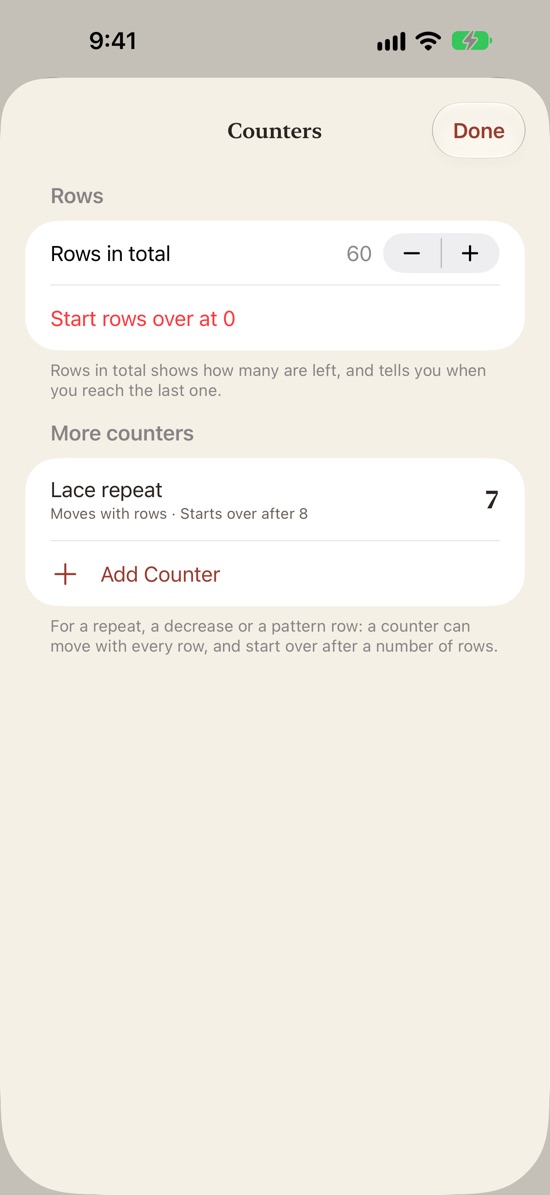
Ballband has a Corner to corner counter for this: you set the blocks wide and blocks high, and it moves with your row counter, telling you for each diagonal row whether to increase, keep level or decrease, and how many blocks the row has.
Questions
How many rows are in a C2C blanket?
Blocks wide plus blocks high minus one. A 30 × 40 graph has 69 rows; a 50 × 50 square has 99.
When do I start decreasing in C2C?
On a square, right after the row where the diagonal reaches the full width. On a rectangle, the side that reaches the short edge starts decreasing at row S + 1 while the other side keeps increasing; both sides decrease from row L + 1 onwards.
Why is my C2C rectangle turning into a square?
Usually because both ends kept increasing past the short side, or both started decreasing too early. Check that the straight rows have the same number of blocks as the short side.
Do I count the starting block as row 1?
Yes. The single block in the corner is row 1; row 2 has two blocks.
- Simply Yarn: How to do corner to corner crochet (Becky Skuse, 19 July 2021), checked 22 Nov 2026.
- Marly Bird: Corner-to-Corner Rectangle Using Half Double Crochet, checked 22 Nov 2026.
- Lion Brand Notebook: 5 Things You Should Know about Corner to Corner Crochet, checked 22 Nov 2026.
- Craft Yarn Council: Crochet Abbreviations Master List (ch, dc, sl st, sp), checked 22 Nov 2026.